Most lists of gross motor activities for preschoolers are the same seven or eight games repeated across hundreds of sites: animal walks, an obstacle course, catch. This is that same core set of gross motor activities — because it’s genuinely the right set, not because nothing else exists — but with something most versions skip: which underlying skill each activity trains, why that skill matters for a child’s development, how to tell it’s working, and what to do when it isn’t.
Why Gross Motor Skills Matter, Beyond the Playground
Gross motor skills are the large-muscle movements behind running, jumping, climbing, and balancing — as opposed to fine motor skills, which cover smaller, precise movements like holding a crayon. Building gross motor skills isn’t only about physical activities for their own sake. Children who develop gross motor skills early tend to feel more confident trying new challenges, which supports social interaction with peers; gross motor skill development is also linked to cognitive and language development, since motor planning and language processing draw on overlapping systems in a young child’s brain. Practically, children with better-developed motor skills and body awareness are less likely to get injured during ordinary outdoor play, since they’re better at catching themselves and adjusting mid-movement.
Motor development doesn’t progress at the same pace for every child. In one multi-center study of preschoolers on the autism spectrum, gross motor developmental delay was identified in roughly two-thirds of the children in that cohort — a reminder that gross motor skill development is worth paying attention to broadly, not something to assume will resolve on its own if a child seems consistently behind peers across many everyday activities, not just occasionally.
Why These Seven, Specifically
Balance and coordination skills aren’t one skill — they’re at least five, and a good rotation of gross motor activities should cover all five without redundancy:
| Activity | Static balance | Balance while moving | Motor planning | Using both body sides | Hand-eye coordination |
| 1. Animal walks | ✓ | ✓ | |||
| 2. Chalk jump-and-move path | ✓ | ✓ | |||
| 3. Balance line / low beam | ✓ | ✓ | |||
| 4. Obstacle course | ✓ | ✓ | ✓ | ||
| 5. Toss and catch | ✓ | ||||
| 6. Follow the Leader | ✓ | ✓ | ✓ | ||
| 7. Balance-bike steering | ✓ | ✓ |
Static balance is holding a position without falling — standing on one leg, pausing mid-pose. Dynamic balance (balance while moving) is staying controlled while the body is in motion — walking a line, riding a bike.
Motor planning (sometimes called praxis) is the brain’s ability to figure out, sequence, and execute a movement pattern it hasn’t automated yet, which is why novel combinations train it better than repeating one familiar motion. Bilateral coordination is using both sides of the body together, often doing different things. Hand-eye coordination is timing hand movement to what the eyes track.
No single activity here builds all five gross motor skills at once — that’s deliberate. If your child strongly avoids one of these seven, it’s worth noticing which skill they’re avoiding, not just that they’re avoiding “exercise.”
What’s Actually Happening in the Body
This is a simplified explanation, not a clinical one, but it’s worth knowing because it explains why “just let them run around” doesn’t cover the same ground as these specific gross motor activities.
Balance depends heavily on the vestibular system — fluid-filled structures in the inner ear that sense head movement and position relative to gravity. Coordination depends on proprioception — sensory input from muscles, joints, and tendons that tells the brain where a body part is without looking at it, which underlies body awareness generally. And putting together an unfamiliar movement at all — not just repeating a learned one — depends on motor planning, which is why a preschooler can often walk a straight line fine but freeze up the first time they’re asked to walk it backward: the vestibular and proprioceptive input hasn’t changed, but the planning demand has.
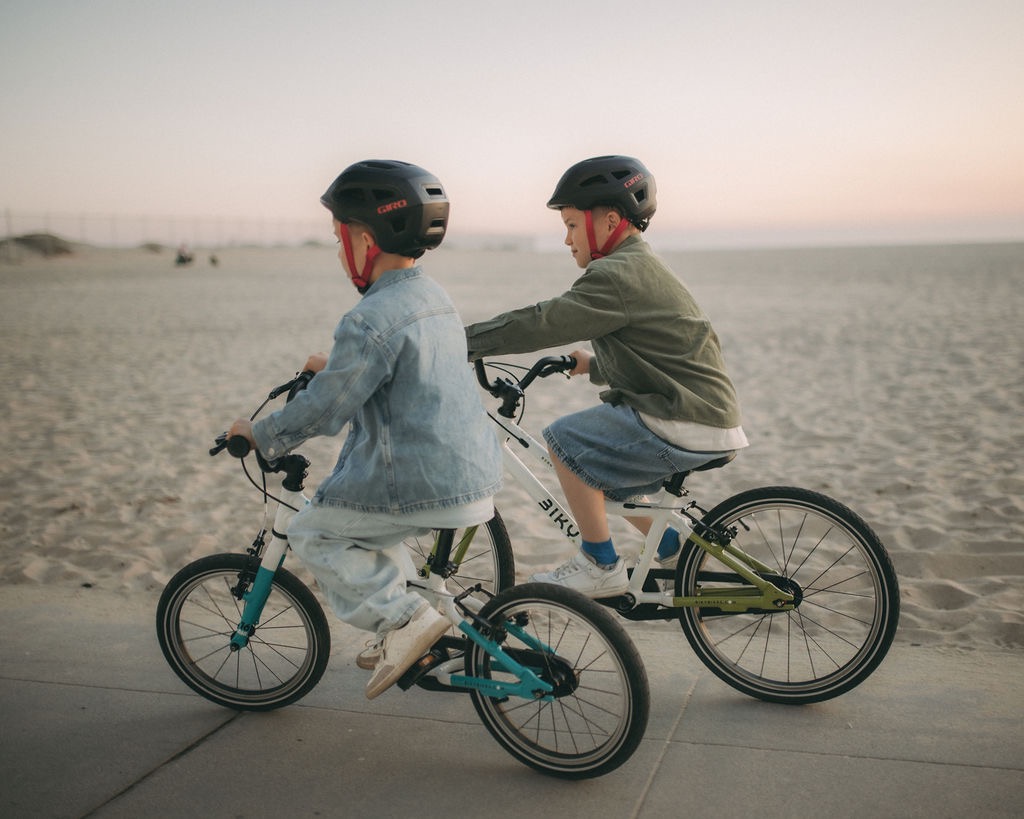
Alt: Kids riding bikes while practicing dynamic balance and coordination
This is also why variety matters more than repetition once a movement pattern feels automatic. Doing the same balance-beam walk daily for a month trains that specific movement; mixing in a chalk path, an obstacle course, and Follow the Leader forces the brain to keep planning rather than executing on autopilot — closer to what unpredictable real-world movement (tripping, catching yourself, dodging a sibling) actually demands.
What’s Typical, By Age
The activities below suit most children roughly 2–5 years old; one (balance-bike steering) commonly starts younger, since balance bikes are often introduced before the toddler-to-preschooler transition. For context — not a checklist to “pass” — CDC’s developmental milestone checklists list catching a large ball most of the time as a movement milestone by age 4, and hopping on one foot as a milestone by age 5.
| Age | Movement milestones most children reach by this age* |
| ~3 years | Runs, climbs, pedals a tricycle, kicks a ball forward |
| ~4 years | Catches a large ball most of the time, hops briefly on one foot, climbs well |
| ~5 years | Hops on one foot, may skip, briefly balances on one leg with more control |
*Based on CDC’s 4-year and 5-year checklists — what most children (75%+) can do by that age, not a deadline for any individual child’s development.
If your child hops confidently at one age and later seems to lose that skill, that’s a different, more worth-flagging pattern than simply not being there yet — see the troubleshooting section below.
WHO’s physical activity guidance for children under 5 recommends at least 180 minutes of activity spread through the day for preschoolers, with at least 60 of those minutes at moderate-to-vigorous intensity. These seven gross motor activities are a structured slice of that — a good 10–15 minutes a day is more useful than one long session once a week, since motor learning comes from repeated, varied practice over time, not volume in a single sitting.
The Seven Activities
1. Animal Walks
Best for: roughly 2–5 years · Trains: static balance, using both sides of the body together, upper body strength
Cross a small space in a few different ways: bear walk (hands and feet, forward — builds upper body strength and core strength), crab walk (hands and feet, facing up), frog jumps (squat and jump), flamingo stand (pause on one foot). Alternating limbs in the bear and crab walks is what makes this a bilateral-coordination activity, not just a strength one — different body positions also build general muscle strength along the way.
Sign it’s working: the flamingo pause gets a little longer, or a little steadier, over a few weeks — not that it becomes perfect.
If it’s not clicking: a child who avoids the crab walk specifically (weight on hands, facing up) is often avoiding the wrist extension it requires, not the balance component — try the bear walk more and reintroduce the crab walk later rather than pushing through discomfort.
2. Chalk Jump-and-Move Path
Best for: roughly 3–5 years · Trains: balance while moving, motor planning
Draw a chalk path with a straight section, jump marks, a zigzag, and a stop point: walk → jump → hop → turn → stop. Switching between movement patterns is the point — add a hop on one leg (single-leg balance) only once it’s comfortable; CDC lists hopping as a 5-year milestone, so treat it as an optional extra challenge, not a requirement.
Sign it’s working: fewer hesitation pauses between sections of the path over repeated tries.
If it’s not clicking: a child who does each element fine alone but falls apart the moment they’re strung together is showing a motor-planning gap specifically, not a balance one — shorten the sequence to two steps and rebuild from there. A short walking-backward stretch is a good next challenge once the forward path feels easy.
3. Balance Line or Low Balance Beam
Best for: roughly 2–5 years · Trains: static balance, balance while moving, postural control
Painter’s tape indoors, chalk outside, or a very low, stable balance beam with clear space around it. Progress through: walking forward, taking sideways steps, walking backward, pausing at a marked spot, and briefly lifting one leg (single-leg balance) when comfortable. Static balance shows up in the pause; balance-while-moving shows up in staying controlled as the body travels — both draw on postural control, the ongoing small adjustments that keep a child upright without thinking about it.
Sign it’s working: arms come down from the wide “tightrope” position over time — that startled, wide-arm reflex is the vestibular system compensating hard; it easing off is the real progress marker, more than perfect footing. This is also what actually builds good balance skills over repeated sessions, not any single balance beam attempt.
If it’s not clicking, avoid uneven surfaces to make it “harder”—that adds a less controllable variable and can produce more falls than skill. A simple balance line on flat, predictable ground is a better challenge than an unstable one.
4. Build a Simple Obstacle Course
Best for: roughly 3–5 years · Trains: balance while moving, motor planning, bilateral coordination
Walk around a cone, step over a line, crawl under something stable, jump between markers, finish on a balance spot. The value is in the transitions — standing to crawling, crawling to jumping — not the completion time. Practical variations (adding a station, carrying an object through the course, or removing a station for an easier version) let one obstacle course serve very different comfort levels.
Sign it’s working: smoother transitions between stations, not faster overall speed.
If it’s not clicking: a child who does every station well alone but rushes and falls apart in the full sequence is often overwhelmed by the number of transitions, not the individual movements — cut it to three stations before adding more back for an extra challenge.
5. Toss and Catch
Best for: roughly 2–5 years · Trains: hand-eye coordination
Start with something large, soft, and slow — a roll, then a gentle two-handed toss, then catching, then a target. Balloons or lightweight scarves are useful variants here: they move slowly through the air, which buys a child more processing time and makes this a gentler way to build hand-eye coordination without constant drops. CDC lists catching a large ball most of the time as a 4-year milestone; that’s context, not a benchmark to hit on a schedule.
Sign it’s working: hands start moving to meet the ball before it arrives, rather than reacting after contact.
If it’s not clicking: a child who flinches or turns away from a thrown object more than peers their age may be reacting to visual tracking difficulty rather than catching skill specifically — slow it down further (the balloon or scarf option above) before assuming it’s a coordination issue at all.
6. Follow the Leader
Best for: roughly 2–5 years · Trains: static balance, balance while moving, motor planning
Build a copy-the-sequence game: walk → turn, then walk → turn → hop → reach → step sideways → freeze. Watching, remembering, and reproducing someone else’s sequence is a different cognitive load than generating your own movement, which is exactly why it’s on this list separately from the chalk path. A round of freeze dance (music, then a sudden stop) is a natural extension of the same skill, and dancing more broadly improves balance, coordination, and body awareness together, which is why it’s worth mixing in even outside this specific game.
Sign it’s working: the sequence can grow by one step without falling apart.
If it’s not clicking: two actions, not six, is the right starting point for most 2–3-year-olds — this is one of the easiest gross motor activities to make too hard too fast accidentally.
7. Balance-Bike Steering and Gliding
Best for: roughly 18 months–5 years, on a pedal-free bike · Trains: balance while moving, motor planning
Walk the bike forward while seated, push into a short glide, steer around one marker, stop, turn. This combines balance-while-moving and steering-specific movement planning in a way none of the other six gross motor activities do — it’s the only one that requires balancing and navigating around an external obstacle at the same time.
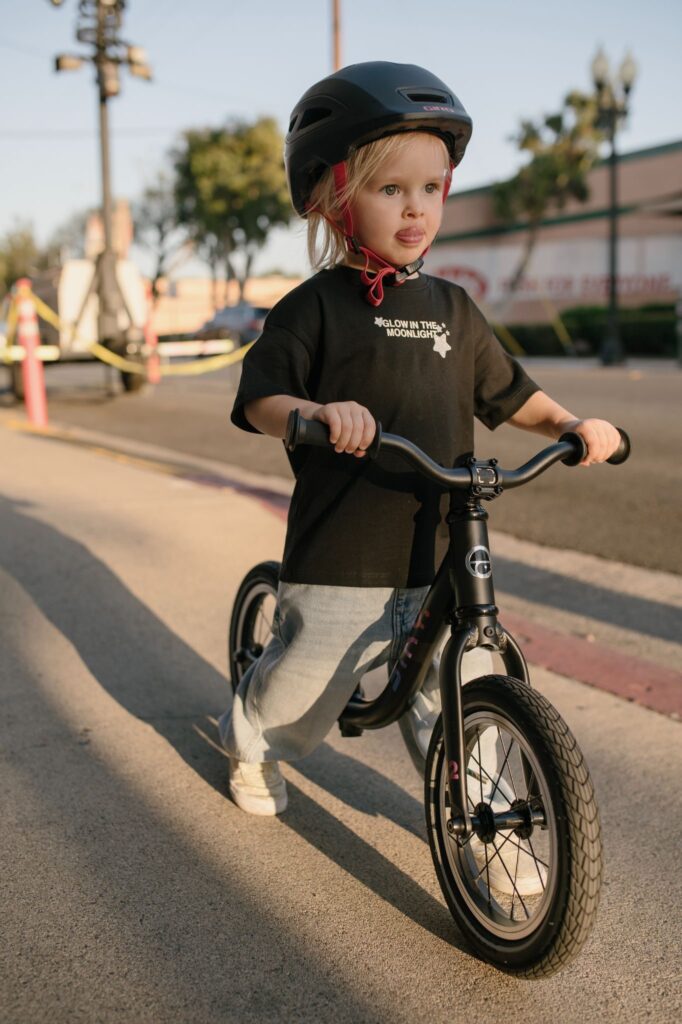
Alt: Kids riding bikes while practicing dynamic balance and coordination
What the research actually shows: a controlled study of 98 preschoolers (ages 3–6) in Spain found a 9-week structured balance-bike program closed an initial motor-competence gap between an intervention and control group on standardized testing (the Movement Assessment Battery for Children-2) across manual dexterity, balance, and overall score. It’s one study, not a guarantee for every child — and some of the most-cited “balance bikes improve balance” claims online trace back to manufacturer-funded press releases rather than peer-reviewed research, which is a different kind of evidence.
Safety first: adult supervision, off the street, a properly fitted helmet meeting the federal CPSC bicycle-helmet standard on every ride — this is AAP guidance, not optional advice.
If you’re shopping for a first balance bike rather than practicing on one you already own: our checklist on buying a kids’ bike covers sizing and fit in detail, and the Biky Air 12 is one lightweight option built for this age range — worth knowing about, though the activity above works with any properly sized balance bike.
Extending the Matrix, By Skill Gap
Once the core seven feel comfortable, here’s how to build gross motor skills further and develop gross motor skills you haven’t specifically targeted yet — the skill matrix above tells you exactly where to add more, rather than adding more at random. Most of these double as outdoor gross motor activities once you’re at a playground or in the yard:
- Need more upper body strength or core strength? More bear-walk and crab-walk repetitions, or a round of jumping jacks, work the same muscle groups the animal walks target.
- Need more body awareness specifically? A few kid-friendly yoga poses — tree pose, or standing on one leg with arms out — are effectively a single-leg balance exercise in a calmer, slower shape than the other six games.
- Need more rhythm and lower-body movement? Jumping rope with an adult holding one end, or a dance party with jumping, spinning, and freezing in turns, both add a rhythm-driven layer to the same coordination skills already in play.
- Want a lower-stakes version of any of the above? Playground equipment — a low balance beam, monkey bars, a slide with stairs — covers most of the same balance games and balance activities in a format many preschoolers already enjoy and self-select into during outdoor play.
Mixing free, unstructured play with a handful of these guided balance activities tends to develop balance and coordination more reliably than repeating the same single fun game every day. None of this needs to feel like a drill — treat it as fun activities and fun games first, and let the skill-building happen as a side effect, not the stated goal.
Every child develops these motor skills at a different pace, and varying which balance exercises and balance activities you practice matters more than mastering any single one first. A few minutes of practice balance work spread across different games can challenge balance in more directions than one repeated drill, and tends to build body coordination and balance skills together rather than one narrow skill in isolation — which is really the whole logic behind rotating through the matrix above instead of picking one favorite and sticking with it.
When None of This Seems to Be Working
Two patterns are worth telling apart, because they call for different responses:
Weak balance skills in one context and strong balance skills in another (steady on a bike, wobbly on a beam) is normal and doesn’t need troubleshooting on its own — the two-pattern distinction below matters when the gap shows up everywhere, not just between activities.
“Cautious, not behind.” Some children hang back from every new physical challenge — not because they can’t do it, but because they’re assessing risk more carefully than an average peer. These kids often do fine on all seven activities once they’ve watched a few times and feel safe. Forcing faster participation tends to backfire; letting them watch first usually doesn’t cost you anything.
“Consistently behind across contexts, not just avoidant.” A child who struggles with balance and coordination everywhere — at the playground, in these activities, in ordinary daily movement like stairs or getting dressed — and who isn’t simply being cautious is a different situation than a child who’s fine everywhere except one specific new game.
When It’s Worth a Conversation With Your Pediatrician
CDC’s checklists describe typical ranges, not diagnostic thresholds. Bring it up at your next well-child visit — or sooner if you’re concerned — if you notice:
- A skill your child clearly used to have that they’ve lost
- Consistent, marked unsteadiness well past the age when most peers have stabilized (not one bad week — an ongoing pattern)
- Avoidance of all physical or movement play, not just one or two specific activities.
- Your own persistent concern about your child’s development, even without a specific milestone you can point to — CDC’s own guidance is that a parent’s concern is itself worth raising, not something to wait out
None of this is diagnostic on its own. It’s a reason to ask, not a reason to worry alone.
FAQ
How often should we actually do these? There’s no strict minimum for this specific list of seven, but WHO’s broader guidance for this age suggests at least 180 minutes of activity a day, part of it moderate-to-vigorous. In practice, 10–15 minutes of these games most days beats one long session once a week — motor learning comes from spaced, varied repetition, not volume in a single sitting.
Is my child behind if they can’t hop on one foot yet? Not necessarily — CDC lists that as a milestone most children reach by around age 5, so a 3- or 4-year-old who can’t do it yet is often simply not there developmentally. It’s a different situation if a child hops fine one month and clearly loses that ability later, which is worth mentioning to a pediatrician.
Can practicing these actually change anything, or is coordination mostly just timing and genetics? Both play a role, and a handful of sessions won’t produce dramatic change — but the Spain study cited above found a structured 9-week program measurably closed a motor-competence gap versus a control group. The evidence supports consistency over weeks, not any single session.
What’s the real difference between “cautious” and “behind”? A cautious child performs fine once they feel safe enough to try, often after watching a few rounds. A child who is behind struggles across many unrelated contexts, not just new or unfamiliar games — see the troubleshooting section above for more on telling these apart.
Do we need any special equipment, or does playground equipment cover this? No special equipment is required — painter’s tape, sidewalk chalk, a soft ball, and open floor or yard space cover six of the seven, and a playground’s climbing structures, balance beam, and monkey bars naturally reinforce several of the same skills. The seventh activity needs a properly sized balance bike.
Editorial note: this piece deliberately covers fewer activities than most competing lists, in exchange for explaining what each one trains, how to tell it’s working, and what to do when it isn’t — that trade-off is the point, not an oversight. Sourcing: CDC (developmental milestones), AAP (activity and bike-safety guidance), WHO (activity-volume guidance), and two peer-reviewed studies (Navarro-Patón et al., 2024, and a multi-center ASD motor-delay study), all linked inline. No claim in this piece is presented as more certain than its source supports.

Two Jersey Moms, a pediatric occupational therapist & elementary school teacher, providing fun and simple activities to get your little ones learning through play.